Understanding before shortcuts
Tools become more powerful when the student has the knowledge to steer, scrutinize and develop what they produce.
A physical school · Stockholm · Grades 4–9
Brighter Future is what an excellent school must become in the age of superintelligence: human at its core, strengthened by technology, built to let curiosity reach further.
Brighter Future is in its application phase. Opening requires approval from the Swedish Schools Inspectorate (Skolinspektionen).
Human-first.
AI-augmented.
Superintelligence was coined by Ilya Sutskever, among others working to build it safely, such as Safe Superintelligence Inc., the research company Ilya Sutskever co-founded.READ ABOUT THEIR WORK
The world changed
Education must rethink what a young person needs to know, understand and do when intelligent machines become part of everyday life.
What must we understand ourselves to think freely? What can technology help us explore faster and more ambitiously? And which human abilities become even more important?
This is not about rejecting the school we have. It is about building what is now possible, with teachers, relationships and solid knowledge as the starting point.
Our education system rests on assumptions shaped by another time. When the tools for thinking and inquiry change this profoundly, adjusting at the edges is not enough. The foundations must be tested anew, and that can only be done from a blank page: a school built from the ground up, under the rules that apply today.
A school built from a blank page, not an older school with new tools.
The industrialization of intelligence
That is why the education system works like a funnel, a wide net meant to catch the few with the greatest ability to think. Now intelligence is being industrialized. When it is no longer scarce, sorting loses its purpose, and school must answer what it should really develop.
In fall 2026, OpenAI presented proposed proofs for hundreds of open mathematical problems. Much is still being reviewed by mathematicians, but the direction is clear: tasks that once required some of the sharpest minds in the world can now be tackled by machines.
Sort people by how well they think. A funnel that catches the few.
Develop everyone's ability to decide where thinking should go, and why.
AI is a vehicle. The human decides where it goes, and why the journey is worth making.
Even a self-driving car lets the human choose the destination. The task of education is to make sure it stays that way.
Nobody drives a car through a marathon, even though it would arrive faster. Running keeps its value, but for different reasons than before. The same will be true of thinking without tools: worth practicing for its own sake. What moves humanity forward are people steering the new intellectual vehicles. The mathematician Terence Tao has compared the arrival of AI in mathematics to the arrival of the car in cities built for pedestrians and horses.
Our hypothesis
A student who starts 4th grade when the school opens in 2028 finishes school in 2035 and goes on to work through the 2040s. Nobody can describe that future in detail. The direction is still clear: the intelligence and capability of these systems keep growing, probably faster over time. So the education rests on what becomes more valuable as the systems improve, not less: the ability to set direction, scrutinize and take responsibility.
The image we hold on to is a boat that rises with the tide. As the systems' capability rises, what students take with them should not sink but lift with it. That is the hypothesis behind the school, and it is proven by actually building the school.
Our starting point
Technology extends human ability. It never replaces the student's thinking or the teacher's judgment.
support adaptation, feedback, exploration and access to knowledge.
makes judgments, builds relationships, challenges, gives context and takes responsibility.
The teachers
The teacher's task is changing at its core: understanding what is valuable to teach, and helping every student understand why learning still matters. That support is needed early, already in teacher education. Today the system tells teachers not to change, while society says everything is changing. A school that takes the future seriously must take that tension seriously too.
telling apart what the student must understand deeply and what the tools can carry.
because deep understanding is what lets tools strengthen thinking rather than replace it.
Two things at once
Students will do well in today's system and be ready for the world it was not built for. One makes the other possible.
Performance by traditional measures is the floor, not the ceiling.

Curiosity with less friction
A spontaneous question can start a long chain of learning. The examples show the direction, not a fixed curriculum.
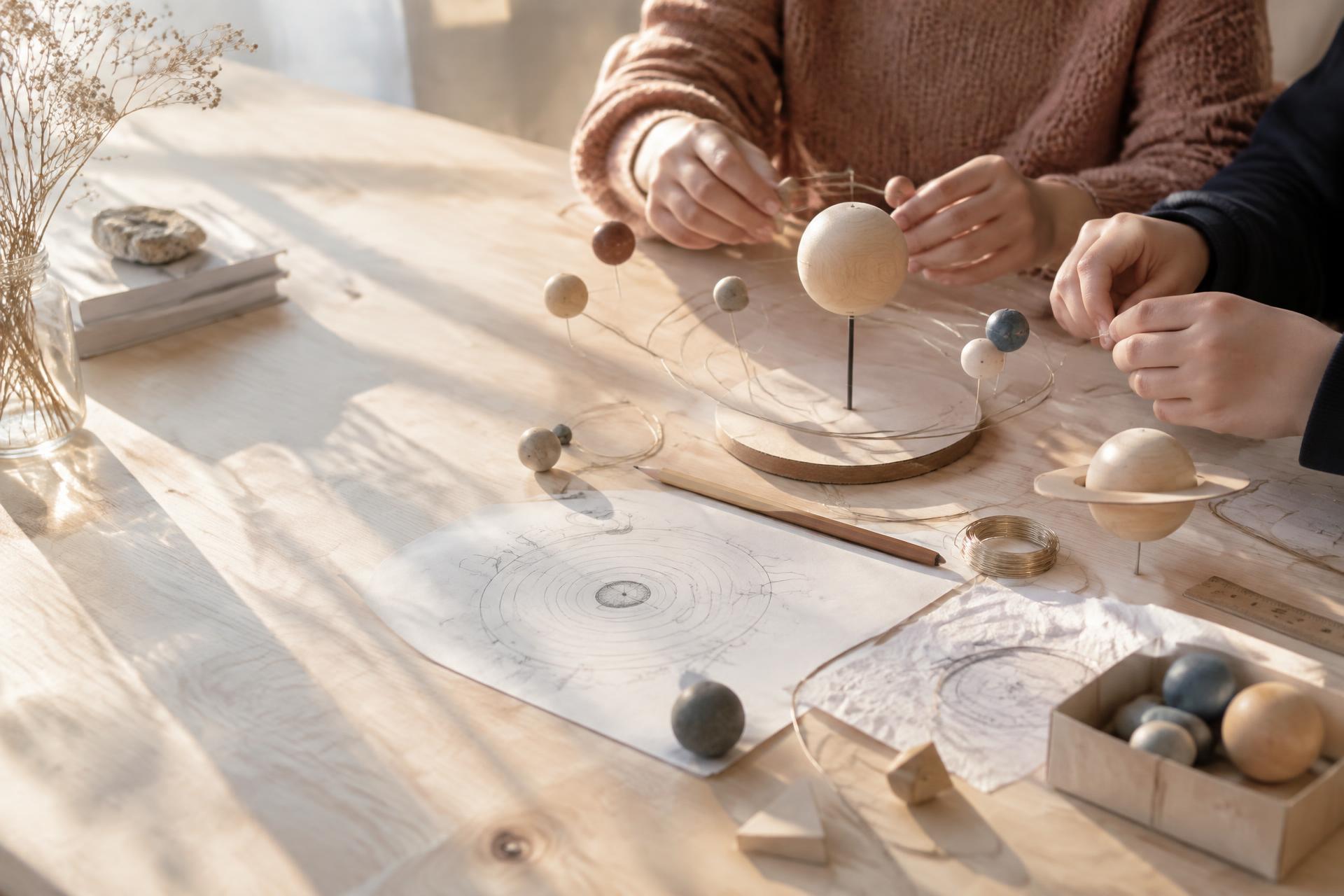
A question about an orbit
mathematics → simulation → code → physics → dataWhy do some diseases spread faster?
biology → statistics → research → models → experimentsWhat makes a city fair and alive?
history → economics → maps → data → policy → simulationA school day
The direction is clear: students should use today's most powerful tools on real, human questions. AI-driven research, AI-supported problem solving, policy analysis, historical research, architecture and building. The tool is never the point. The question is: how do we use AI in a credible and sustainable way to move humanity forward? This is the shape of the day, not a fixed timetable.
Coming together, orientation and direction for the day. People meet first.
Mathematics, writing and science. What should be understood deeply is practiced deeply. For advanced tool use to hold, the foundations must be in place.
Students investigate real questions: historical sources are analyzed, political decisions dissected, hypotheses tested against data, with teachers challenging reasoning, sources and conclusions.
Time together, recovery and physical activity.
AI-supported problem solving and architecture: simulate a neighborhood, analyze a social problem and propose policy, design and build physical structures. Exploration that starts as an idea can end as something that actually stands in the room.
Body, expression, collaboration and encounters with the world outside the classroom.
What did you learn, and what did the tools do for you? Students practice judging when AI extends their ability and when it would replace it.
AI runs through the way of working where it extends human ability, never as a substitute for the understanding students should build themselves. The tools are also designed for learning: they guide students in how to use them well.
Principles for learning
Tools become more powerful when the student has the knowledge to steer, scrutinize and develop what they produce.
Students need to learn what they must know themselves, what technology can strengthen and where it risks weakening learning.
Ideas become clearer when they meet materials, experiments, data and real constraints.
The teacher's judgment, classmates' perspectives and belonging to a group are central parts of school.
Good tools reduce the friction of inquiry and let students follow questions further.
The tools should not only answer in a Socratic way. They should teach students how to work with an AI system and notice when someone does not know how to use it for learning. Then it guides them, so the student decides the direction instead of following the tool.
A demonstration project
Brighter Future is not being built to become a large school chain. It is an exceptional environment where the education of the future is developed carefully, for real.
What works must benefit more students and teachers over time, whether or not they ever attend our school.
Mimer Labs works on questions of learning, knowledge and technology. Brighter Future is the project's physical school.
Founding families
Your registration of interest helps us understand real demand ahead of the application and lets you follow the project as it develops.
This is not an application for a school place, guarantees no place and gives no priority on any future waitlist.
The road ahead
The educational model, student demand and dialogue are developed.
The application is submitted to the Swedish Schools Inspectorate by January 31, 2027.
Continued work, subject to the necessary approvals.
The school opens in the fall of 2028. Establishment requires approval from the Swedish Schools Inspectorate.
Frequently asked questions